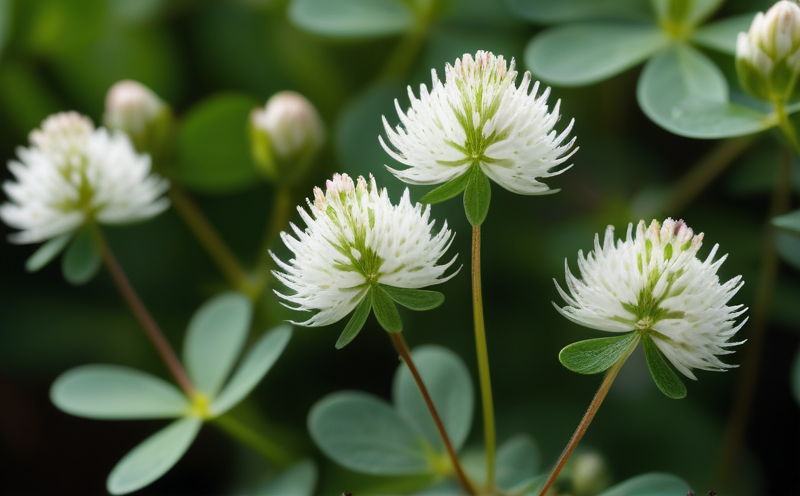
🌿 Clover (White)

Trifolium repens
herbs perennial legume / groundcover
Illustration of Clover (White)
☀️ Sun
full sun to partial shade
💧 Water
moderate (drought-tolerant once established)
🗺️ Zones
3–10
🪴 Soil Type
loam to clay; tolerates wide range including compacted
🧪 Soil pH
6.0–7.0
💧 Drainage
moist but well-drained; tolerates occasional wet
📏 Spacing
4–6 inches (broadcast seeded for living mulch)
📐 Height
4–8 inches
📅 Days to Maturity
60–90 days (perennial, established within first season)

🍴 Edible Parts

🍽️ flowers (tea🍽️ salads🍽️ fritters🍽️ flour from dried blossoms)🍽️ leaves (salads🍽️ cooked greens🍽️ tea)🍽️ seeds (sprouted)

🤝 Companions (8)

🤝 Corn
Classic Three Sisters companion: clover fixes nitrogen that heavy-feeding corn depletes; low-growing clover doesn't shade corn.
Clover living mulch suppresses weeds around brassicas, fixes nitrogen they need for leaf growth, and retains soil moisture.
Clover mulch reduces soil splash on tomatoes (preventing blight) and fixes nitrogen; attracts pollinators for fruit set.
🤝 Squash
Clover groundcover suppresses weeds beneath sprawling squash; fixes nitrogen; clover flowers attract squash pollinators.
🤝 Apple
Orchard understory clover fixes nitrogen for trees, suppresses grass competition, attracts pollinators during apple bloom.
Clover provides living mulch maintaining soil moisture blueberries need; fixes nitrogen in acid soil when inoculated with proper Rhizobium strain.
Low-growing clover between strawberry rows suppresses weeds, fixes nitrogen for berry production, and retains soil moisture.
🤝 Grape
Vineyard row middles planted with clover fix nitrogen, prevent erosion on slopes, and attract beneficial insects.

⚠️ Keep Apart (3)

⚠️ Allium
Onions, garlic, and leeks are inhibited by clover's dense mat growth; alliums prefer bare soil around their bulbs for proper formation.
Clover's dense surface roots compete with carrot taproots for space and moisture; can cause forked carrots.
Beets need open soil for root expansion; clover matting crowds beet roots causing stunted, misshapen development.

💊 Medicinal Uses

Blood purifier, alterative, antispasmodic. Used for gout, rheumatism, coughs, menopause symptoms (red clover for phytoestrogens). White clover contains salicylic acid (aspirin-like), coumarins (mild blood thinning), and isoflavones. Flower tea traditionally used for arthritis, colds, and as a detoxifying spring tonic.

📜 History & Traditional Uses

Sacred to Celtic druids — three-leaved clover represented the triad (earth/sea/sky); four-leaf clovers as good luck charms. Medieval Christians adopted shamrock (Trifolium dubium) to represent the Trinity via St. Patrick. Used as 'bee bread' — crucial nectar source for European honey production. Pioneers planted it as 'green manure' to restore exhausted farmland. American agricultural revolution relied on clover in crop rotation.

📝 Notes

World-class nitrogen fixer — fixes 100-200 lbs nitrogen per acre annually through Rhizobium symbiosis. Outstanding living mulch: suppresses weeds, retains soil moisture, prevents erosion. Attracts bees and beneficial insects heavily. White clover (Trifolium repens) spreads by stolons — excellent permanent groundcover. Red clover (Trifolium pratense) is taller, biennial/short-lived perennial with deeper taproot. Crimson clover (Trifolium incarnatum) is a showy winter annual. All fix nitrogen. 'Dutch White' and 'New Zealand White' are low-growing lawn alternatives.